

Introduction
NPTEL — National Programme on Technology Enhanced Learning — is a government-backed platform offering 12-week courses taught by IIT and IISc professors across hundreds of subjects. What makes it genuinely different from every other online course you’ve enthusiastically enrolled in and quietly abandoned is this: your college can register it as an elective. It counts toward your CGPA. With the right subject, the right approach, and a reasonable amount of effort, you can meaningfully improve your numbers in a semester without a single 8 AM class, a single attendance register, or a single lab report.
What NPTEL Actually Is and How It Works
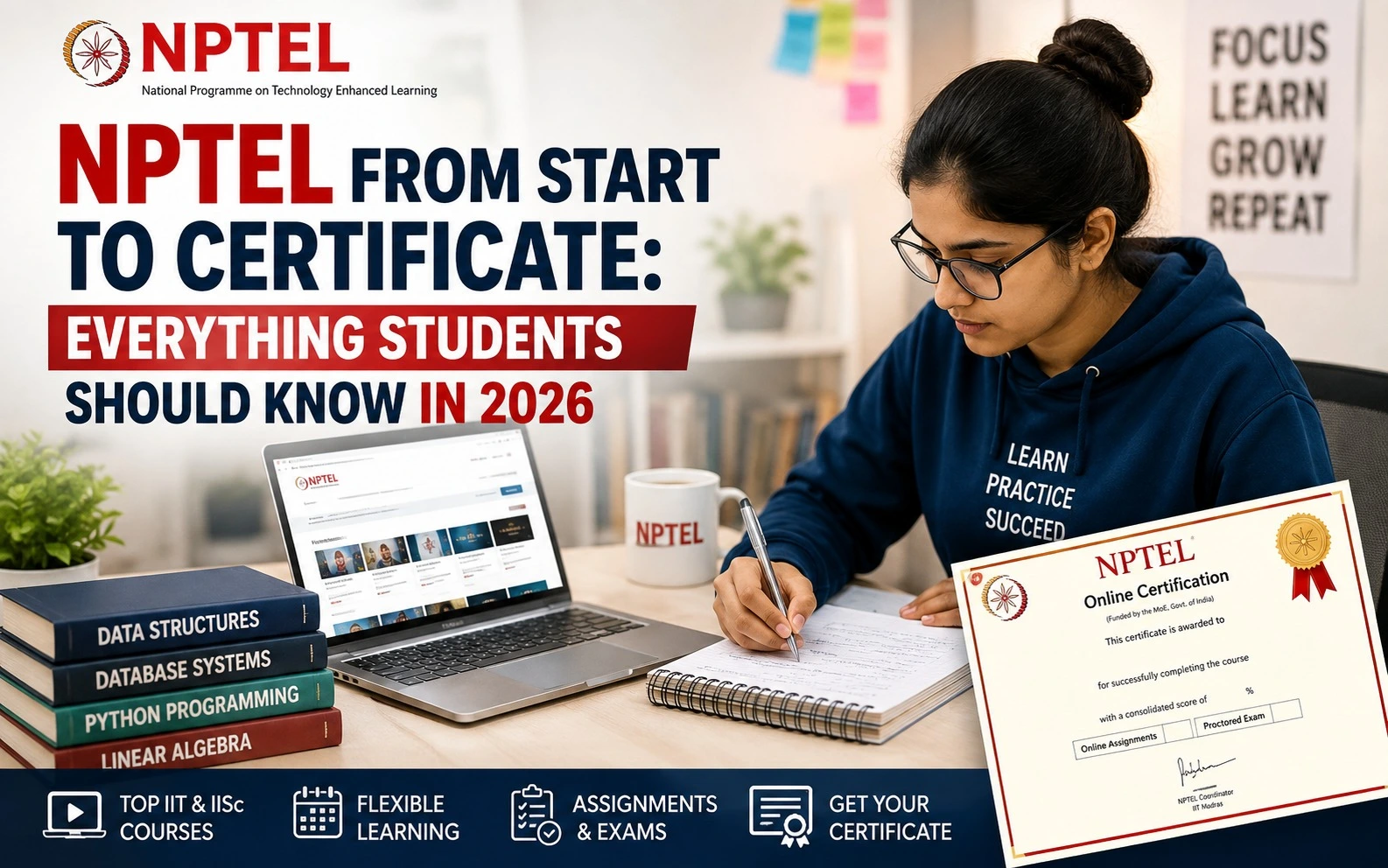
No attendance. No practicals. No internal exams. The entire course runs at your own pace, on your own schedule, from wherever you have internet access. The only two requirements are weekly assignments over 12 weeks and one three-hour exam at the end.
The content is available in both video and transcript form on the NPTEL website. Watch the lectures or read the written material. For most people, reading is faster and works just as well. The platform is clean and well organised, and everything you need is available without having to chase notes from someone who attended class.
NPTEL has been running since 2003 and currently offers over 1,900 courses across engineering, science, humanities, and management. The courses are peer-reviewed, nationally recognised, and backed by some of the most credible academic institutions in the country.
The 25/75 Split You Need to Understand
Twenty-five percent of your final score comes from weekly assignments. Twelve weeks of assignments; the best eight out of these twelve form a quarter of your total marks. These are available to attempt any time during the week they are open, and resources to work through them are widely available across YouTube, previous year compilations, and study groups. This portion of your score, with consistent effort, can be close to perfect.
The remaining 75% is the three-hour end-of-semester exam. Most are held on Sundays, some on Saturdays, at designated Computer Based Test centres in the city chosen by you as per your convenience. Here is what most people do not know going in: you are allowed to leave after the halfway point. And for well-chosen subjects, most students are comfortably done within sixty to ninety minutes.
Most exams are MCQ-based. Some include numeric and integer-type answers. A few have descriptive sections. If improving your CGPA is the primary goal, look for subjects where the exam is entirely MCQ. It genuinely makes the experience smoother and the preparation more targeted.
How Your Score Converts to a Grade Point
Your NPTEL final score is converted to a grade point, and most colleges follow a distribution along these lines when mapping the result:
- 95 and above gets a 10
- 85 to 94 gets a 9
- 72 to 84 gets an 8
- 60 to 71 gets a 7
- Below 60 may not count toward your CGPA or receive a lower grade, depending on your college’s policy, or may result in a backlog.
Choosing the Right Subject Is the Most Important Decision You Will Make
Not all NPTEL courses are equal in difficulty, and the difference between a well-chosen subject and a poorly chosen one can be the difference between a 10 and a 7 on your CGPA.
Subjects like Introduction to Cognitive Psychology, Conservation Geography, Psychology of Learning, Affective Computing, and Industrial Internet of Things consistently produce high scorers. The papers lean heavily on MCQs; the questions are fair, and the majority of what appears in the exam comes from assignment material and previous years.
The single most useful thing you can do before registering for any subject is this: visit the official NPTEL portal and look up the score statistics for that course. The platform publishes topper scores, maximum marks, score distributions, and percentile cutoffs for every exam. If the topper scored full marks, the paper is approachable. If the national maximum score is eighty out of a hundred, the course is harder and the curve more competitive. This data is free, public, and completely removes the guesswork from your decision.
One more thing worth knowing: NPTEL uses relative grading. You are placed in the top one percent, two percent, five percent, and so on, nationally. If your batch registers for the same subject together, you are being graded within a familiar pool, and the distribution tends to work in your favour. If you pick something niche independently, you are competing against the most motivated students in that subject from across the country. Unless you are very confident in the material, going with your batch is the more reliable strategy.
How to Prepare Without Overwhelming Yourself
Start two weeks before the exam. Not because the content is vast, but because two weeks gives you enough time to go through the material once and revise the assignments properly without cramming.
Go through the course content at least once. You do not need to memorise every concept. You need enough familiarity that when a question appears on exam day, it does not feel foreign. The content is genuinely well made. NPTEL professors explain things clearly, and many students find the material more engaging than they expected.
Revise at least three years of previous assignments thoroughly. For most accessible subjects, eighty to ninety percent of the exam questions come from this pool. If you have done this revision, you walk into the exam having already encountered most of what you will be asked.
What You Walk Away With
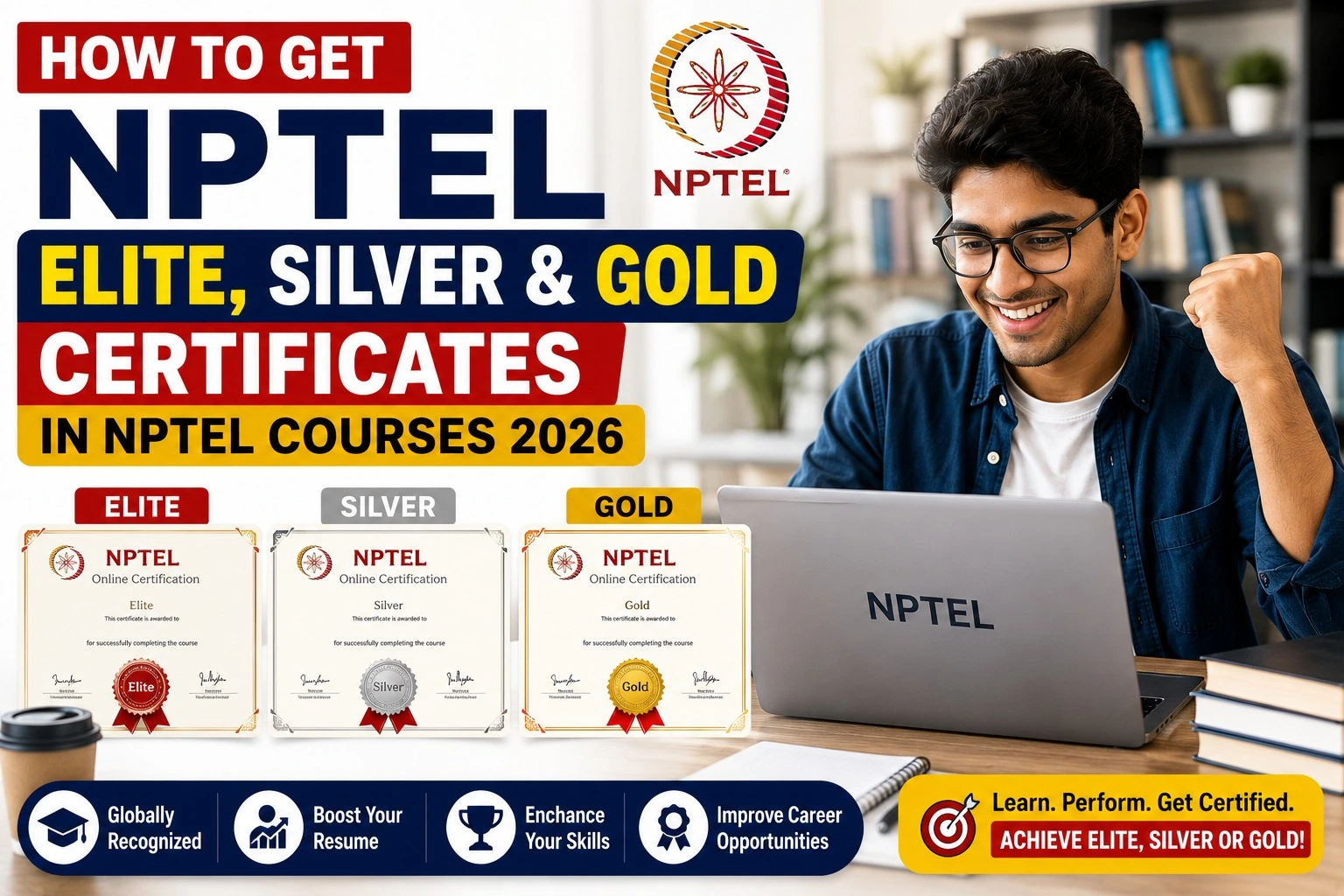
Results are typically declared two to three weeks after the exam. Your outcome is categorised as a Gold Medal, Silver Medal, Elite, or a completion certificate below that. All categories are valid credentials. The medal tiers are the ones that carry real weight on a resume, particularly for postgraduate applications or roles where academic credibility matters. These are IIT-backed, nationally ranked certifications that hold up in ways most online course certificates simply do not.
The CGPA improvement is the immediate reason most students come to NPTEL. The certification is what stays on the resume for years after the semester ends.